
Kindergarten Starts Before the First Bell Rings: What Our Early Learning Center Connecticut K-Readiness Program Does in August to Prepare Children
By Lisa Chaplinsky, Town & Country Early Learning Centers
The school supply lists start showing up in inboxes in August. The Facebook groups fill up with questions about which backpack holds a lunchbox and whether a child should know how to write their name by now. The anxiety that has been quietly building since spring gets loud.
I understand it. Kindergarten feels like a threshold, and Connecticut parents want to know their child is ready to cross it with confidence. After nearly 30 years of watching children leave our K-Readiness classrooms in Middletown, Southington, and Colchester and walk into their first day of elementary school, I want to share what we actually focus on in August and what you can do at home to support it.
Because kindergarten readiness is not about what your child knows. It is about what your child can do.
“Kindergarten readiness is not a checklist. It is a collection of small, practiced moments that add up to a child who knows how to be part of something bigger than themselves.”
What Connecticut Kindergarten Teachers Actually Want From Incoming Students
The research on this is clear and consistent, and it may surprise you. A study published in the Elementary School Journal surveyed kindergarten teachers across the country and asked them to rank the skills they most wanted children to arrive with. The top answers were not academic. They were: the ability to communicate needs and wants, the ability to follow simple directions in a group, the ability to take turns and share, and the ability to manage basic self-care independently. Letters and numbers ranked well below all of these. (Lin et al., 2003.)
Connecticut’s own kindergarten frameworks, aligned with CT Childcare regulations, aligned with the Common Core and the CT ELDS standards that our Middletown center helped pilot as a designated CT ELDS pilot site, reflect the same priorities. Foundational literacy and numeracy matter, and we teach them deliberately, but the children who thrive in kindergarten in Middletown, Southington, and Colchester school districts are the ones who can sit with a feeling, wait for their turn, ask for help when they need it, and try again when something is hard.
How Our Licensed Preschool and K-Readiness Program in Connecticut Prepares Children in August
In our K-Readiness classrooms this August at our licensed preschool and daycare in Middletown, CT, Southington, and Colchester centers, teachers are focusing on five specific areas, all grounded in our Building Blocks of Learning® curriculum and aligned with Connecticut’s Early Learning and Development Standards.
- Transition practice: Moving from one activity to another with a two-minute warning. Cleaning up a space and moving to the next thing. These transitions happen dozens of times a day in kindergarten, and children who haven’t practiced them spend the first weeks of school managing the transition instead of the learning.
- Group listening: Sitting on a rug with a group of peers and listening to a story or set of directions without needing to be the one talking. This is a skill, and it takes practice. We build it all year, and August is when we push the duration.
- Self-advocacy: Teaching children to say “I need help” instead of shutting down, and “I don’t understand” instead of guessing and moving on. NAEYC accreditation CT guidelines on school readiness specifically identify self-advocacy as a social-emotional skill with direct impact on academic outcomes. (NAEYC, 2022.)
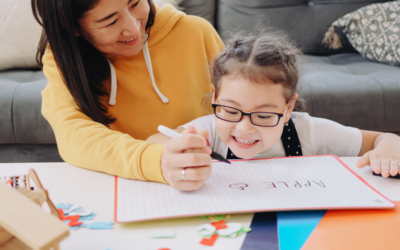
- Fine motor precision: Holding a pencil, using scissors, managing a zipper on a lunchbox. Children who struggle with these tasks spend cognitive energy on the physical mechanics instead of the learning those mechanics are meant to produce. We work on fine motor skills every day through art, building, and hands-on activities.
- Name recognition and early print awareness: Not mastery of reading. Awareness that print carries meaning, that words go left to right, that their name is made of specific letters in a specific order. The National Early Literacy Panel has identified print awareness as one of the six early literacy skills most predictive of later reading success. (National Early Literacy Panel, 2008.)
Valbona Mukollari, Director of our Southington childcare center, puts it this way:
“What I see every August in our K-Readiness room is children who are ready in ways their parents haven’t noticed yet, because some of the skills that matter most aren’t the ones parents think to look for.”
Five Things Connecticut Parents Can Do at Home to Support Kindergarten Readiness This August
These are not worksheets. They are real moments that take five to ten minutes and cost nothing.
- Practice the drop-off. If your child will be walking into a new Connecticut elementary school after finishing preschool programs in CT in September, drive by it a few times in August. Walk up to the door. Talk about what will happen on day one in plain, specific language. “You will walk in, hang up your backpack on a hook with your name on it, and find your seat.” Children manage transitions better when they have a mental map of what comes next.
- Read together every night, and let them hold the book. Run your finger under the words as you read. Ask them to find the first letter of their name on the page. Stop before the last page of a story you’ve read before and ask what comes next. These are the print awareness habits that the National Early Literacy Panel identifies as foundational, and they build in minutes a night over months.
- Let them pour their own cereal, zip their own bag, and put on their own shoes. Even when it’s slower. Especially when it’s slower. Independence with self-care tasks is one of the clearest predictors of a smooth kindergarten transition, and the confidence a child builds from doing something themselves carries into every other part of their day.
- Play Simon Says. Genuinely. It builds listening, impulse control, and the ability to follow group directions, which are three of the skills kindergarten teachers ranked highest. It takes four minutes before dinner and requires nothing except you.
- Talk about feelings by name. Not “are you okay?” but “it looks like you might be frustrated. Is that right?” The more specific emotional vocabulary a child has going into kindergarten, the better equipped they are to manage the social complexity of a classroom full of new people. Research from the Yale Center for Emotional Intelligence shows that emotional literacy has direct impact on academic engagement and peer relationships in early elementary school. (Yale Center for Emotional Intelligence, 2013.)
“The goal of August isn’t to cram. It is to arrive calm, curious, and ready to try.”
What Connecticut Parents Should Know If They Are Anxious About Kindergarten Readiness
If you are anxious about your child’s kindergarten readiness, that is completely normal and worth naming. The parents who call our Middletown, Southington, and Colchester centers in August, worried their child isn’t ready, are almost always parents of children who are more ready than they think. The children I have watched struggle in the transition were rarely underprepared academically. They were underprepared emotionally, and that is a gap that closes with time, practice, and adults around them who stay calm and consistent.
That is what we do every day in our K-Readiness classrooms in Middletown, Southington, and Colchester. And it is what you can do every day between now and September, one bedtime story and one pair of shoes at a time.
Kindergarten is coming. Your child is more ready than you think.
If you’d like to see our K-Readiness program for school readiness Connecticut in person, talk through where your child is developmentally, or ask about enrollment at our preschool and childcare centers in Middletown, Southington, or Colchester, we’d love to hear from you. Call our Middletown center at 860.347.1400, Southington at 860.628.7900, or Colchester at 860.603.5055. We’re open Monday through Friday, 6:30 AM to 6:00 PM, year-round.
Sources: Lin H-L, Lawrence FR, Gorrell J. “Kindergarten Teachers’ Views of Children’s Readiness for School.” Elementary School Journal. 2003. / National Early Literacy Panel. “Developing Early Literacy: Report of the National Early Literacy Panel.” 2008. / NAEYC. “Developmentally Appropriate Practice in Early Childhood Programs Serving Children from Birth Through Age 8.” 4th edition, 2022. / Yale Center for Emotional Intelligence. “Emotional Intelligence and Academic Performance.” 2013. / Connecticut Office of Early Childhood. Connecticut Early Learning and Development Standards (CT ELDS). Revised 2014.