
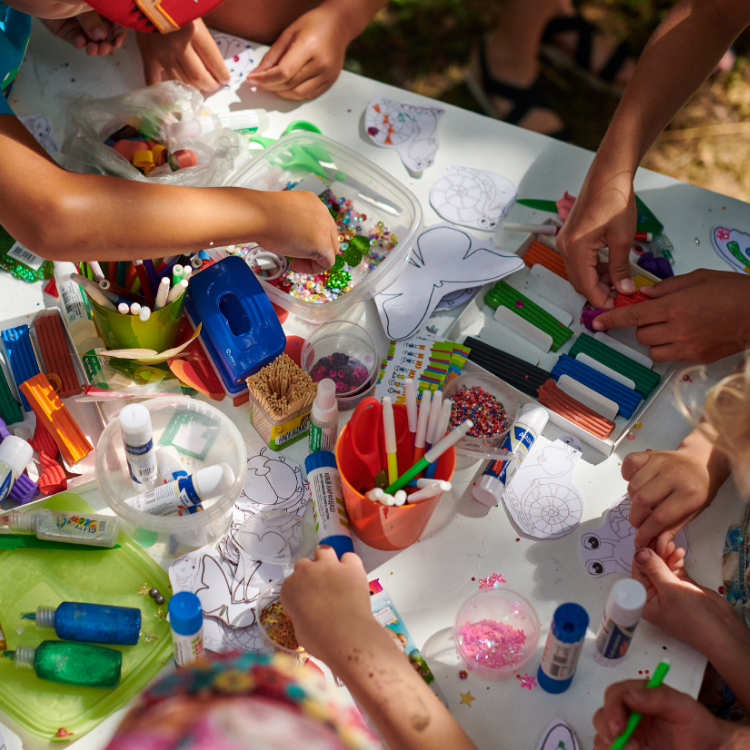
What We’re Making in July: Five Hands-On Activities from Our Classrooms You Can Do at Home This Weekend
By Lisa Chaplinsky, Town & Country Early Learning Centers
Every July, I watch something happen in our classrooms that I wish every parent could see. A three-year-old shakes a jar of cream for four minutes straight, completely focused, and then opens it and finds butter. A four-year-old mixes red and yellow food dye in a cup of water and stops mid-stir, genuinely surprised, when it turns orange. A five-year-old arranges rocks and leaves into a pattern on the table and then explains it to the child sitting next to them.
None of these moments came from a workbook. All of them came from our Building Blocks of Learning® Early Learning Center Connecticut curriculum, which our teachers deliver every day at our daycare in Middletown, CT and preschool centers in Southington and Colchester. And all of them are things you can do at home this weekend with materials you already have.
Here are five of our favorites.
“The best learning tools for a young child are usually already in your kitchen or your backyard. The trick is knowing what you’re actually building when you use them.”
Why Hands-On Activities at Home Support School readiness Connecticut for Preschoolers
Before we get into the activities, it helps to understand why these kinds of experiences matter so much at this age. The research is consistent and clear. Children between two and six years old learn primarily through direct physical experience with materials, not through observation or instruction. Jean Piaget’s foundational work on cognitive development identified this stage, which he called the preoperational stage, as the period when children construct understanding by doing, touching, pouring, mixing, and building. (Piaget, 1952.)
NAEYC accreditation CT guidelines on developmentally appropriate practice reinforce this, identifying hands-on, child-directed exploration as one of the primary vehicles for learning across every developmental domain, cognitive, social-emotional, physical, and language. (NAEYC, 2022.)
What this means practically is that when your child makes something at home with you, they are not just having fun. They are building the neural pathways that support later academic learning, and they are doing it in the context of a relationship with you, which research from the Harvard Center on the Developing Child identifies as one of the most powerful drivers of healthy development. (Center on the Developing Child, Harvard University, 2011.)
With that in mind, here are five activities our teachers use in July at our daycare in Southington, CT and our Middletown and Colchester centers, each one tied to specific developmental goals, and each one simple enough to try before the weekend is over.
Activity 1:
Shake-a-Jar Butter
- What you need: A small jar with a tight lid, heavy whipping cream, a pinch of salt, crackers for tasting.
- What you do: Pour about a quarter cup of heavy cream into the jar, add a pinch of salt, seal the lid tightly, and let your child shake it. And shake it. And shake it some more. In about five to eight minutes, the cream will thicken into whipped cream, and then, if they keep going, separate into a solid butter and a thin liquid called buttermilk. Spread it on a cracker and eat it.
- What it builds: Persistence and executive function, because the result requires sustained effort and does not come quickly. Fine motor strength from gripping and shaking. Scientific thinking from observing a physical transformation. Language from describing what they feel happening inside the jar as the texture changes.
One of our Middletown parents wrote in a Google review that her daughter came home one day and could not stop talking about how she had made butter at school. That moment lives in the classroom record in her child’s digital portfolio. It also lives in her daughter’s understanding of what effort produces.
“A child who makes butter from cream understands something about cause and effect that no worksheet can replicate.”
Activity 2:
Color Mixing With Water and Food Dye
- What you need: Three clear cups or jars, water, red and blue and yellow food dye, a spoon.
- What you do: Fill each cup about halfway with water. Add red dye to one, yellow to another, and blue to the third. Then let your child mix them in whatever combinations they choose, red into yellow, blue into red, all three together, and observe what happens.
- What it builds: Scientific inquiry, because your child is forming a hypothesis (“I wonder what happens if I mix these”) and testing it. Color recognition and vocabulary. Cause-and-effect reasoning. And genuine surprise, which is one of the most underrated drivers of learning in early childhood.
This activity maps directly to the scientific thinking standards in CT Childcare regulations and Early Learning and Development Standards, which our Middletown center helped develop as a designated CT ELDS pilot site. It costs less than two dollars and takes about ten minutes to set up.
Activity 3:
Nature Collage
- What you need: A piece of cardboard or thick paper, glue or tape, and whatever your child collects on a walk outside. Leaves, sticks, flower petals, rocks, feathers, bark, grass.
- What you do: Go outside together and collect materials. When you come back, lay everything out and let your child arrange it however they like before gluing it down. No instructions. No template. Their arrangement, their choices.
- What it builds: Creative expression and spatial reasoning from deciding where things go. Classification and sorting from selecting what belongs and what doesn’t. Fine motor control from tearing, arranging, and gluing small pieces. And vocabulary from naming what they found, where they found it, and why they chose it.
Our Here We Move® program takes children outside every single day at our Middletown, Southington, and Colchester centers because we know that time in the natural world is not a break from learning. It is learning. This activity brings that same principle home.
Activity 4:
Water Transfer Pouring Station
- What you need: Two or three containers of different sizes, a pitcher, water, and a towel. Outside or in the bathtub works best.
- What you do: Fill one container with water and let your child pour it, transfer it between containers, try to fill one exactly to the top, and figure out which container holds more. Let them lead. Let them experiment. Let them make a mess.
- What it builds: Early math concepts including volume, capacity, and comparison, which are foundational numeracy skills in Connecticut’s kindergarten readiness frameworks. Fine motor precision and hand-eye coordination from controlled pouring. Concentration and self-regulation from a task that requires patience and attention.
The National Council of Teachers of Mathematics identifies measurement and data as one of the five core content areas in early math education, and pouring activities are among the most effective ways to build it at this age because children experience the concept physically before they are ever asked to represent it symbolically. (NCTM, 2006.)
“The activities that feel like playing are usually doing the most developmental work. That is not a coincidence. It is the point.”
Activity 5:
Painted Rock Storytelling
- What you need: Smooth rocks from outside, washable paint, paintbrushes, and time to dry.
- What you do: Let your child paint the rocks however they like, simple faces, animals, shapes, or abstract patterns. Once they dry, use the rocks as characters or props to tell a story together. Let your child be the author. Ask questions. “What does this one want? Where are they going? What happens next?”
- What it builds: Narrative language and early literacy, because storytelling is one of the six skills the National Early Literacy Panel identifies as most predictive of reading success. Creativity and imaginative thinking. Fine motor control from painting small surfaces with a brush. And the experience of being the one who drives a story, which builds confidence and voice in ways that matter long after the rocks are dry.
This is an activity our teachers return to across age groups because it scales. A two-year-old paints freely and names the colors. A four-year-old builds a whole story with characters and a problem to solve. A five-year-old in our preschool programs in CT in Middletown, Southington, and Colchester might narrate their story to a friend and listen to theirs in return, which is exactly the kind of reciprocal communication kindergarten teachers say they want to see on day one.
How Quality Childcare Connecticut Licensed centers build these skills every day
What makes these activities more than just fun is the intentionality behind them. At Town & Country, our teachers don’t set out materials randomly. Every activity in our Building Blocks of Learning® curriculum is chosen because it targets specific developmental domains for a specific age group, and every observation our teachers make during the activity goes into your child’s digital portfolio through our Observe. Record. Assess. Share. process.
When you try these at home, you don’t need that level of documentation. You just need to be present, ask open-ended questions, and resist the urge to show them the “right” way. The mess is the learning. The wrong answer is the learning. The moment they figure something out on their own is worth more than ten times you showing them how.
If you’d like to see how our teachers build on these kinds of activities in our Quality childcare Connecticut and full-day preschool programs in Middletown, Southington, and Colchester, we’d love to have you come in for a tour. Call our Middletown center at 860.347.1400, Southington at 860.628.7900, or Colchester at 860.603.5055. We’re open Monday through Friday, 6:30 AM to 6:00 PM, year-round.
Sources:
Piaget J. “The Origins of Intelligence in Children.” 1952. / NAEYC. “Developmentally Appropriate Practice in Early Childhood Programs Serving Children from Birth Through Age 8.” 4th edition, 2022. / Center on the Developing Child, Harvard University. “Building the Brain’s ‘Air Traffic Control’ System: How Early Experiences Shape the Development of Executive Function.” 2011. / National Early Literacy Panel. “Developing Early Literacy: Report of the National Early Literacy Panel.” 2008. / National Council of Teachers of Mathematics. “Curriculum Focal Points for Prekindergarten through Grade 8 Mathematics.” 2006. / Connecticut Office of Early Childhood. Connecticut Early Learning and Development Standards (CT ELDS). Revised 2014.
About the Author
Lisa Chaplinsky holds a Master of Science in Curriculum and Instruction and has spent years supporting families across Town & Country Early Learning Centers' three Connecticut locations in Middletown, Southington, and Colchester. She works closely with directors and teaching staff across all three centers and writes from nearly 30 years of collective institutional knowledge watching Connecticut children grow from infants into kindergarteners. You can learn more about our programs at [townandcountryelc.com](link to homepage).