Friendships in Early Childhood: What’s Normal and How We Support It
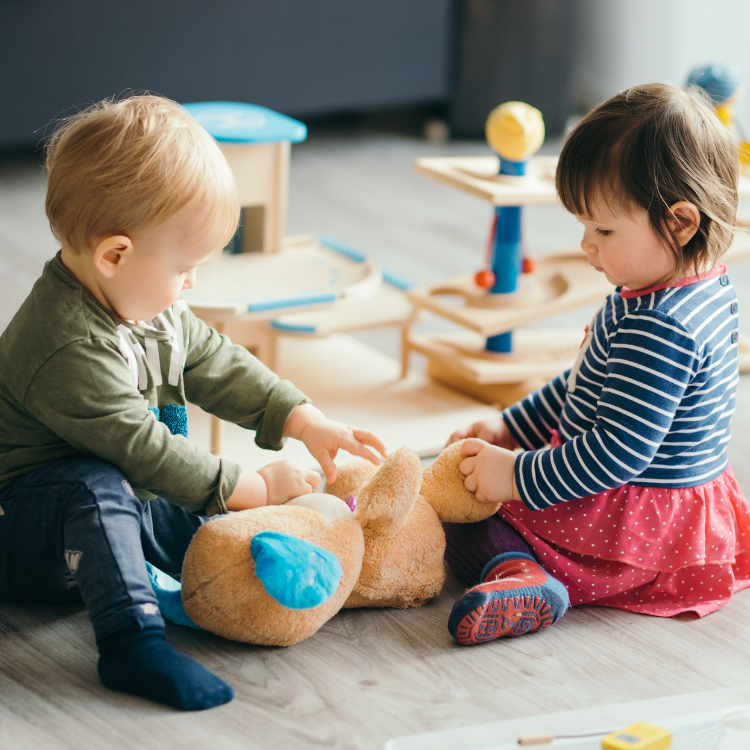
Friendships in early childhood don’t always look the way adults expect- and that’s okay. Young children are still learning how to play together, share space, manage big feelings, and repair after conflict. One day they’re best friends, the next day they’re not- and by lunchtime, they usually are again. Research shows that this kind of back-and-forth is a normal and healthy part of social development in the early years (National Association for the Education of Young Children [NAEYC], 2019).
At our learning center, we support friendship skills by coaching children on how to join play, use words to express feelings, and work through challenges with peers. These skills develop through play, practice, and consistent adult guidance- not by expecting children to “just know” what to do. The American Academy of Pediatrics emphasizes that play is a critical context for learning cooperation, communication, and emotional regulation (American Academy of Pediatrics, 2018).
Families can support this learning at home by talking about feelings, practicing simple phrases like “Can I play?” and celebrating effort rather than perfection. Friendship is a skill, and every child develops it at their own pace.
Family Sidebar: Friendship Skills We’re Practicing This Month
This month, children are practicing important friendship and social skills during daily play and routines, including:
- Joining play with peers using words and body language
- Taking turns and sharing materials with adult support
- Expressing feelings in age-appropriate ways
- Listening to others’ ideas during play
- Solving simple conflicts with guidance
- Practicing inclusion and kindness
- Repairing relationships after disagreements
According to NAEYC, young children benefit most when adults model these skills and guide children through real-life social situations as they happen, rather than stepping in too quickly or relying on punishment (NAEYC, 2010).
Families can support these skills at home by modeling calm language, role-playing social situations, and helping children name emotions during everyday moments.
Frequently Asked Questions About Early Childhood Friendships
What if my child doesn’t seem to have a “best friend”?
That’s completely okay. Many young children move in and out of friendships or prefer playing with different peers at different times. Experts note that at this age, the ability to engage with others and participate in group play is far more important than having one consistent friend (American Academy of Pediatrics, 2018).
My child says someone was “mean” to them. Should I be worried?
Not necessarily. Conflict is a normal part of social learning. Young children are still developing impulse control, perspective-taking, and communication skills. Helping children talk about what happened and how they felt supports emotional growth and problem-solving (HealthyChildren.org, 2021).
What if my child often gets left out?
Being left out can be hard—even for young children. Teachers help children learn how to enter play and include others, and families can support this by practicing simple phrases at home and reinforcing confidence and persistence. Learning how to join play is considered an important developmental skill in the preschool years (Centers for Disease Control and Prevention, 2023).
Is it normal for friendships to change frequently?
Yes. Early childhood friendships are fluid. Children are learning about preferences, group dynamics, and independence, which often leads to changing social connections. This flexibility is typical and developmentally appropriate (NAEYC, 2019).
How can I help my child build friendship skills at home?
Simple, everyday actions make a big difference:
- Talk about feelings during daily routines
- Read books about friendship and discuss characters’ choices
- Practice what to say when joining play
- Keep playdates short and low-pressure
- Praise effort, not just success
The American Academy of Pediatrics highlights that parent modeling and supportive conversations play a key role in helping children form healthy peer relationships (HealthyChildren.org, 2021).
References
- American Academy of Pediatrics. (2018). The power of play: A pediatric role in enhancing development in young children.
https://www.aap.org/en/patient-care/early-childhood/early-childhood-health-and-development/power-of-play/ - Centers for Disease Control and Prevention. (2023). Important milestones: Your child by three years.
https://www.cdc.gov/act-early/milestones/3-years.html - National Association for the Education of Young Children (NAEYC). (2010). Fostering peer interaction in early childhood classrooms.
https://www.naeyc.org/resources/pubs/yc/sept2019/peer-interaction-preschool-social-triangle - National Association for the Education of Young Children (NAEYC). (2019). Peer interaction and social development in preschool.
https://www.naeyc.org/resources/pubs/yc - HealthyChildren.org (American Academy of Pediatrics). (2021). What parents can do to support friendships.
https://www.healthychildren.org/English/family-life/power-of-play/Pages/what-parents-can-do-to-support-friendships.aspx